TL;DR: The Reserve Bank of Australia’s (RBA) cash rate cut to 0.25% in March 2026 will significantly reduce construction loan interest rates across Australia. This offers homeowners opportunities for lower repayments or faster loan payoff. This change could decrease financing costs for new home builds and major renovations by tens of thousands of dollars over the loan term.
Key Takeaways
- The RBA’s cash rate reduction directly influences Australian construction loan interest rates, which typically means lower borrowing costs for you.
- You can anticipate a decrease in your construction loan repayments, potentially saving hundreds of dollars per month on an average $500,000 loan.
- This creates an opportunity to either reduce monthly expenses or accelerate loan repayment, significantly cutting the total interest paid over the life of the loan.
- Lenders will likely get more competitive, so it’s crucial to compare construction loan offerings and negotiate for the best terms.
- Use tools like the HomeBuildBudget Cost Calculator and Builder Quote Comparison to re-evaluate your project budget and secure favourable financing.
- Despite lower interest rates, broader construction costs remain a factor. The ABS (6427.0 Producer Price Index Q4 2025) reported a 1.4% increase in residential building material costs in the last quarter.
What is the RBA Cash Rate Cut and How Does it Affect Your Construction Loan?
The RBA cash rate is the interest rate on overnight loans between banks; it’s a key tool for monetary policy in Australia. When the RBA cuts the cash rate, as it did to 0.25% in March 2026, it signals to commercial banks that their borrowing costs are down, pushing them to lower their own lending rates.
For you, this directly impacts variable-rate construction loans and can influence new fixed-rate offerings. A construction loan is a specific type of finance for building a new home or undertaking a major renovation, typically disbursed in stages as construction progresses. This recent cut means the core cost of borrowing for Australian banks is lower, setting the stage for construction loan interest rates Australia to fall.
How Will Lower RBA Cash Rates Influence Construction Loan Interest Rates?
Lower RBA cash rates directly mean reduced funding costs for Australian banks, prompting them to cut their variable interest rates for borrowers. While the RBA cut was 0.25%, the actual reduction passed on to consumers can vary. However, a significant portion is typically passed through for construction loans. For example, a major bank might reduce its standard variable construction loan rate by 0.20–0.25% within weeks of the RBA announcement, according to analyses from the Australian Financial Review (March 2026).
This reduction makes financing a new home build Australia or a substantial renovation project more affordable. Lenders will often adjust their construction loan offerings to stay competitive. This means you could see more attractive renovation loan rates Australia and new build rates popping up. Even a small reduction can save you thousands over the life of your loan.
Example Construction Loan Interest Rate Comparison
This table illustrates the potential savings on a $500,000 construction loan over 30 years with a 0.25% rate reduction, based on typical current interest rates.
| Loan Amount | Old Interest Rate | New Interest Rate | Old Monthly Repayment | New Monthly Repayment | Monthly Saving | Total Interest Saved (30 years) |
|---|---|---|---|---|---|---|
| $500,000 | 6.25% | 6.00% | $3,078 | $2,998 | $80 | $28,800 |
| $750,000 | 6.25% | 6.00% | $4,617 | $4,497 | $120 | $43,200 |
Calculations are indicative and do not include fees or other charges. Source: HomeBuildBudget indicative modelling, April 2026.
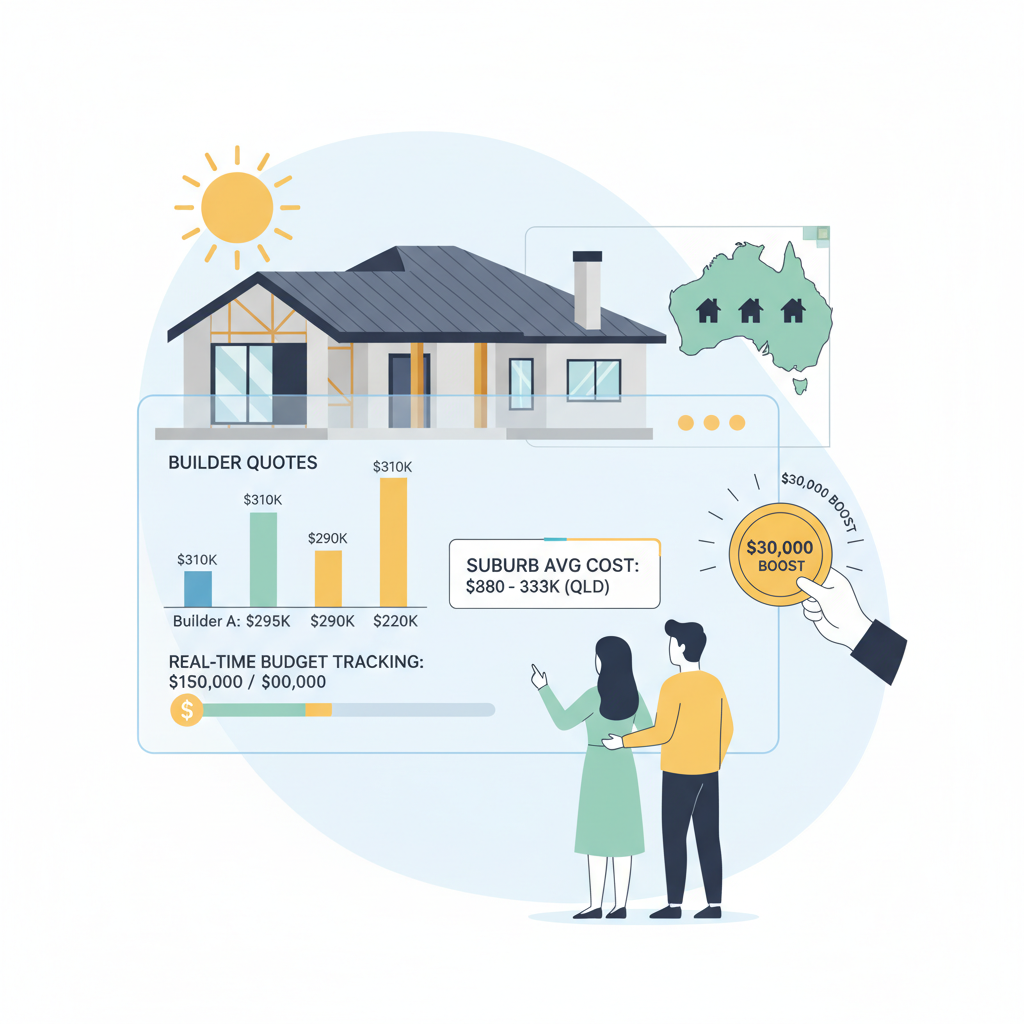
To effectively plan your construction project in this new rate environment, use the HomeBuildBudget Cost Calculator. It allows you to estimate construction costs by room type, material grade, and suburb-level labour rates across Australia. You can then adjust your estimated loan repayments to reflect the lower interest rates and see how this impacts your overall project budget.
What Does This Mean for Your Construction Loan Repayments?
For homeowners with variable rate construction loans, the RBA cash rate cut typically leads to lower construction loan repayments. This reduction frees up cash flow each month, giving you a financial buffer. For instance, on a $500,000 construction loan, a 0.25% rate cut could reduce your monthly repayments by approximately $80, saving you $960 annually.
With this extra cash, you have two main choices:
- Reduce Monthly Outgoings: Simply enjoy the lower repayments and allocate the savings elsewhere in your household budget.
- Pay Off Your Loan Faster: Maintain your previous higher repayment amount. This extra payment goes straight to your principal, significantly cutting the total interest you’ll pay and shortening your loan term. Over a 30-year loan, paying an extra $80 per month could shave years off your mortgage and save you tens of thousands of dollars in interest.
Actively tracking your spending against estimates is crucial. The HomeBuildBudget Budget Tracker allows you to monitor actual spending against your project estimates with real-time alerts when categories exceed thresholds. This helps you identify where you can allocate savings from lower interest rates to either reduce debt faster or manage other build costs.
Can You Secure a Better Deal for Your New Home Build or Renovation Financing?
Yes, a lower RBA cash rate usually sparks more competition among lenders. This is a prime time to snag a better deal for your construction or renovation loan. Lenders will be keen to attract new customers and retain existing ones, potentially offering sharper rates, reduced fees, or more flexible terms. This is particularly relevant for those seeking financing a new home build Australia or pursuing significant renovation loan rates Australia.
It’s always wise to compare offers from multiple financial institutions, even if you already have a pre-approval. Don’t hesitate to negotiate with your current lender, presenting competitive offers you’ve received elsewhere. Many lenders have retention departments willing to match or beat competitors’ rates to keep your business.
When you’re comparing builder quotes, remember that financing costs are only one part of the equation. Use the HomeBuildBudget Builder Quote Comparison tool to compare up to five builder quotes side-by-side. Our AI-powered line item analysis helps you understand where you can save on construction costs, complementing any savings you achieve on your loan interest rates. Additionally, if you’re undertaking a renovation, our Renovation ROI Calculator can help you estimate the return on investment for common renovation types by suburb and property type, ensuring your project is financially sound from all angles.
What are the Risks and Opportunities of a Low Cash Rate Environment?
A low cash rate environment offers big opportunities for borrowers, but it also comes with risks you should consider for your building project. The primary opportunity is the reduced cost of borrowing, making large-scale projects like new builds or extensive renovations more financially accessible and potentially freeing up cash flow. This low-rate period can also stimulate the housing market, potentially increasing property values after your build is complete.
However, risks include the potential for future interest rate increases, which would affect those on variable construction loans. While the current outlook suggests rates may remain low for some time, global economic factors (e.g., the Middle East conflict driving commodity price volatility, as discussed in /blog/middle-east-conflict-drives-double-digit-build-cost-spikes-i) can quickly shift the RBA’s stance. Furthermore, while finance costs are down, overall Australian home building costs surge due to labour and material shortages, as highlighted in /blog/australian-home-building-costs-surge-whats-driving-2026-incr. Always factor in potential cost overruns for your build, independent of interest rates.
When planning your project, it’s wise to consider fixing a portion of your construction loan, or taking out a fixed-rate loan if the rates are attractive, to gain certainty over your repayments. However, this may mean missing out on further rate drops. For a comprehensive overview of the market, also consult reports like the HIA April 2026 Housing Scorecard and read our analysis on the /blog/australian-construction-outlook-2026-record-pipeline-meets-r.
Frequently Asked Questions
What is a construction loan in Australia?
A construction loan in Australia is a specialised home loan designed for building a new home or undertaking significant renovations. Unlike a standard home loan, funds are drawn down in stages as construction milestones are met, rather than as a lump sum upfront. This allows interest to be paid only on the drawn amount, saving you money during the build phase.
How do I compare construction loan interest rates in Australia?
To compare construction loan interest rates Australia, you should gather offers from multiple lenders, including major banks and smaller institutions. Look at both variable and fixed rates, considering comparison rates which include fees. Tools like HomeBuildBudget’s platform can help you budget for these repayments by providing granular cost-per-square-metre data for over 2,500 Australian suburbs, updated quarterly from ABS and industry sources, helping you estimate your total loan amount.
Can I refinance my construction loan if interest rates drop further?
Yes, you can typically refinance your construction loan, even if it’s still in the construction phase or once completed. If RBA cash rate impact construction loans leads to further drops, refinancing could secure you a lower interest rate, reducing your monthly repayments or shortening your loan term. Always check for any exit fees from your current lender and application fees for the new loan.
What is the typical repayment structure for a construction loan?
Construction loan repayments typically start as interest-only payments on the funds drawn down as construction progresses. Once the construction is complete and the final payment is made to the builder, the loan usually converts to a standard principal and interest repayment structure. This helps manage cash flow during the building period.
Should I choose a fixed or variable interest rate for my construction loan now?
The choice between a fixed or variable interest rate depends on your risk tolerance and financial strategy. With lower construction loan repayments currently due to the RBA cut, a variable rate might offer flexibility and benefit from further rate drops. However, a fixed rate provides certainty of repayments, shielding you from future rate increases. Consider your long-term financial stability and current market predictions from sources like the RBA (www.rba.gov.au) or financial advisors.
Capitalising on Lower Construction Loan Rates
The recent RBA cash rate cut offers a big opportunity for Australians looking to build or renovate. Lower construction loan interest rates Australia mean reduced borrowing costs, offering a chance to either ease your monthly financial burden or accelerate your path to debt-free homeownership. Being proactive in comparing loans and managing your project budget will be key to maximising these benefits.
Remember that while financing costs are easing, the overall cost of building can still fluctuate due to materials and labour. Thorough planning and consistent tracking are essential.
Ready to get started? Use HomeBuildBudget to estimate your construction costs, compare builder quotes, and track your spending against your budget.
Get Your Free Estimate → https://homebuildbudget.com/calculator